Creatures of Air
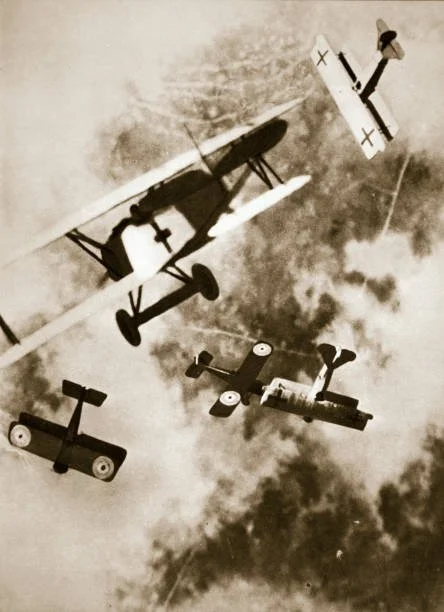
Dogfight Between British and German Aircraft World War I circa 1916-circa 1918.
Eco-Lore has created a Discovery Station at the Air & Space Museum in Washington, D.C., highlighting the culture and contributions of World War I fighter pilots known for their dogfighting skills.
Shining Knights adorned in Chivalry, Respect and Honor
In the skies, the myth of the fighter pilot gained new life through their knightly gallantry. High above the muddy trenches below, aerial combat was regarded as clean and noble. Fighter pilots engaged in a test of skill and daring, participating in elegant aerial dances as they sought to outmaneuver and outperform their opponents. World War I pilots were primarily drawn from the officer class, which contributed to the perception that they held a higher status than the masses who perished daily on the front lines. By 1915 Dogfights in the sky was normal.
The natural environment on the Western Front presented other challenges for fighter pilots
Airplanes during World War I had to contend with extreme winds on the Western Front, where conditions were often unpredictable and fierce. To adapt to these challenging environmental factors, several strategies and design modifications were used. While flying in turbulent conditions remained a challenge, these adaptations significantly improved aircraft stability and pilot safety during the war.
Stronger and More Flexible Structures: The frames of many early aircraft were made of lightweight materials like wood and fabric, but these needed to be sturdy enough to withstand strong winds. The use of flexible materials, such as tight canvas skin stretched over a wooden frame, helped absorb some of the stresses from gusty winds without breaking.
Flying Techniques: Pilots themselves developed techniques to manage extreme wind conditions. For example, when facing crosswinds on takeoff or landing, they often performed a "crab" maneuver, where they would bank the aircraft slightly into the wind to keep the plane aligned with the runway. Additionally, pilots had to learn how to deal with wind gusts by constantly adjusting the controls and using the aircraft’s responsiveness to keep stable flight paths.
Tangible culture of fighter pilots
It was essential for pilots to have specific clothing and equipment to protect themselves from the cold, wind and unpredictable weather while flying over the Western Front. These garments and accessories became integral to the pilots' uniforms, identities, and personification. Unlike other military branches, such as the Navy and Army, fighter pilots developed their own unique style of dress during wartime activities. This established traditions and customs that would influence future dogfighters.
Pilots often named their planes to create a connection and foster a sense of attachment to the aircraft that would help them survive aerial conflicts and ultimately return home to their families after the war. This practice was akin to relying on a trusted sled or hunting dog, both of which are companions that support you in battle. The reliability of these airplanes was crucial; it could mean the difference between life and death. Factors like how the plane flew, its durability, and its consistency in landing safely all contributed to the belief that giving the aircraft a name would bring it to life.
Dogfighting intangible expressive culture
The term came into existence because two women fighting is called a catfight, and all early fighter pilots were men, hence dogfight. When fighter pilots encounter one another, it was not uncommon for them to begin a mad scramble of evasive moves that ultimately led to a chase. The style of fighting was face to face because of the open cockpits. When two fighter pilots were matched up against one another that were extremely skilled they would go towards each other and bank into a left turn then begins the circling, the dance. This is done to determine their enemy skill level. The first pass did not tell you it was the turn of the plane. How quickly could they turn and gain altitude.
Flying and Combat Maneuvers During Dogfights:
Aircraft were initially used as mobile observation vehicles and early pilots gave little thought to aerial combat. Once machine guns were mounted to the plane, either in a turret or higher on the wings of early biplanes, the era of air combat began. The wind's direction and force impact airplane navigation, with the prevailing westerly winds on the Western Front benefiting German aviators. These factors led to airplanes taking evasive action and performing split-second acrobatic movements during fights. A new (esoteric) specialized language was created by pilots to describe the dangerous and exciting events occurring over the Western Front in the blazing skies of WWI.
1. Pitches Up is to climb up and come down in an arch to position your airplane behind the enemy plane tail.
2. A Half Loop is to climb to go inverted then roll out at the top
3. Roll Right and pull into each other. Usually done in a circle with each plane to test the other pilot’s flying skill and capabilities.
4. Roll Over the plane looping over top of the enemy
5. Peals Under dive away
6. Rake shooting enemy crossing in front of you “In line of fire”
7. Bob and Weave to not fly on a straight level
8. Head on Pass is to fly right by one another avoiding a head on collision.
9. Rocking Wings was a signal to other pilots in your squadron to attack.
10. Pours In shooting or firing
11. Squadron would consist of five or more airplanes.
12. Dicta Boelcke, written by Oswald Boelcke, an ace pilot in 1916 during WWI the book was created for aerial combat rules for engagement. Many of Boelcke's concepts, conceived in 1916, are still applicable today, including use of sun and altitude, surprise attacks, and turning to meet a threat.
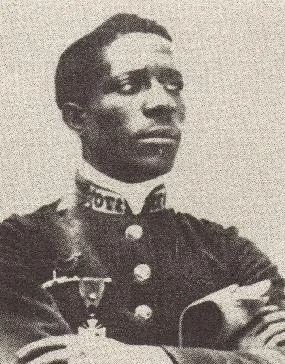
Eugene Bullard was an African American pilot who flew for France during WWI as a fighter pilot. He was nicknamed the Black Swan Death and is quoted for saying:
“Tout sang est rouge; All blood runs red.”