The Land Knows no Color
Historical Agriculture Practices of Black Washingtonians.

Deanwood’s Suburban Gardens amusement park. Photo by William Henry Jones, Scurlock Studio (1927). From The New York Public Library
The Forgotten Soil
Washington, DC, has a rich history of African American culture and accomplishments that convey the ingenuity and resilience of an oppressed community. An intricate faucet of this cultural expression is the agricultural heritage passed on from ancestors as far back as Africa. Africans are innate farmers and understand the land and how to cultivate the soil to produce nutritious nourishment. African Americans, having originated from Africa, have a deep and long history of agricultural farming in the United States. The agricultural presence in the United States is primarily due to the skilled hand of African Americans who nurtured these customs in Africa and were one of the main reasons Africans were enslaved and brought to Americas in the early 1600’s.
Because of the lack of access to economic mobility, many Black men and women had to grow their food to feed large families. Most Black Americans were farmers and sharecroppers before and after the Civil War (1861-65). In 1868, in Washington, DC, the Federal Bureau of Freedmen purchased a section of the city in Southeast Anacostia named Barry Farms. It was established to give 40,000 newly freed enslaved refugees of African Americans a place to live, build housing, and have access to 359 acres of lots where vegetables and fruits were grown. Their ability to understand the soil, various crops' growing tendencies, and seasonal changes through astronomy allowed them to survive harsh circumstances with minimum resources. Many Black Washingtonians migrated from the South to northern cities during the great migration between 1910 and 1970 and brought with them this esoteric traditional knowledge and utilization of orally passed-down techniques for agriculture. At one point in American history, it was common for people to have gardens in their front or back yards.
Land ownership was essential for living and surviving off the fruits and vegetables that could be useful in barter and trade. A vital commodity for harmed communities that live by the African creed is "It takes an entire village to raise a child." The ability to grow their own food allowed Black Americans to compensate for low wages, racial injustices, and provided relief for themselves and their communities. The exhibition and documentation of this traditional trade will explore Black Washingtonians' intrinsic value to the land and the sustainable regeneration methods they use in agriculture. Culture and environment are intertwined and shaped by one another while influencing people’s behavior and the ecosystem. The goal of the project is to show the interdisciplinary components of agriculture, urban sustainability and African American culture, history, and traditions.
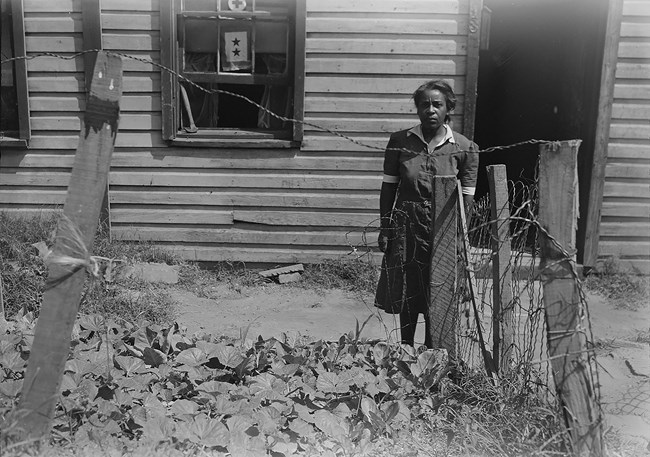
Black woman gardener in Southwest DC in front of her victory garden during WWII. Courtesy of the Library of Congress.
BARTER & TRADE
Barter and trade, deeply ingrained in the historical fabric of African American culture, originated in Africa's empires, villages, and communities long before enslaved people arrived in the United States. The late 1860s saw a burgeoning of African American communities in Washington DC, near the forts located inside the city after the Civil War ended. In places like Washington DC, Deanwood neighbors would trade vegetables with other neighbors for fruits and vegetables they were not growing. This historical practice of barter and trade was a significant part of African American culture, shaping how communities interacted and survived. Deanwood, once farmland worked by enslaved Black people, testified to the community's resilience and adaptability. The tradition worked well because one often had a surplus of the vegetables and fruits you grew but not the variety needed for a diverse food selection. Owning land and homes provided resources and space for farming and gardening. The sense and use of space were integral to the growth and development of Deanwood. Neighbors having access to different food options creates a unique foodways culture. In segregated Black neighborhoods up until the 1960s, the socioeconomic hierarchy comprised janitors, carpenters, teachers, doctors, and lawyers. Food sharing supplied healthy choices and community-built relationships that might have never been formed.
Folklore, Tradition and Oral Communication
When we talk about folklore, we are delving into cultural expressions deeply rooted in traditions, oral communication, and variations of the specific cultural expression based on the regional location from which it originated. Farming and gardening are vernacular traditions passed down through communities, groups, and ethnic affiliations. The culture surrounding cultivating land for food access is present in every culture for survival and sustained customs, representing the community's identity. Many people learn about gardening and farming from listening to their parents, grandparents, and other planters talk about it. Sharing information through questions and observation helps people find solutions as they work the earth's soil to create life that nourishes the body, mind, and spirit. There is a symbiotic relationship between the person and the environment when planting the seeds, learning to commune, and understanding what the land and seasons convey to produce vegetables, herbs, fruits, and flowers. An intimate negotiation is intertwined in the partnership of the planter and nature—the inception of foodways binding cultural expression.
“Hucksters”
In Washington, DC, Deanwood, and many other towns and cities, a cultural expression emerged from the need for diverse and healthy food options within communities. Many residents began planting gardens in plots next to their houses or in their backyards. To address the lack of markets or grocery stores in marginalized areas, enterprising individuals known as hucksters set up small mobile grocery stores using wooden carts with wheels to sell vegetables, fruits, and certain meats. These hucksters would walk through neighborhoods, announcing their available items and ringing a bell to attract residents to come and purchase food.
As many hucksters had a surplus of homegrown goods, they seized the opportunity to create a circular economy by both living and selling within their communities. This tradition began in the late 1800s but gradually faded away as local grocery stores owned by Black and Jewish entrepreneurs started offering a broader and more diverse range of options, rendering hucksters' services less relevant in the communities they once served.